Joining technologies for e-mobility & battery production

Industries

From the battery cell to the complete battery system, e-mobility production places the highest demands on process reliability, lightweight construction through mixed-material design, automatability due to high production volumes and extremely short cycle times, as well as traceability. TOX® supports manufacturers of battery modules, battery housings, and battery systems with innovative joining technologies, pressing systems, and automated production solutions for e-mobility. This results in efficient, scalable, and quality-assured manufacturing processes for the electric mobility of tomorrow.

Challenges in battery production

Battery production is one of the most demanding manufacturing sectors in modern industry. From the production of individual battery cells to the assembly of battery modules and the manufacture of complete battery systems, a wide variety of materials must be processed precisely, safely, and cost-effectively. At the same time, requirements for lightweight construction, energy efficiency, process reliability, and traceability are constantly increasing.

TOX® supports companies in the e-mobility and battery industries with high-performance joining technologies, precise pressing systems, and intelligent automation solutions. Our technologies help optimize manufacturing processes, reliably meet quality requirements, and sustainably increase the cost-effectiveness of battery production.

Typical challenges include:

  • process-reliable and reproducible joints, even between different materials

  • monitored and documented joining processes with complete traceability

  • a high degree of automation with maximum system availability and minimal cycle times

  • minimal thermal and mechanical stress on sensitive battery components

  • flexible joining technologies for different materials and applications

  • water- and gas-tight joints for battery modules and battery housings

  • electrically conductive joints even with challenging material combinations

Joining technologies for battery modules – reliable joints for battery cells, modules, and housings

In battery production, precise and process-reliable joints are crucial for the quality, safety, and service life of modern battery systems. TOX® offers innovative joining technologies and high-performance pressing systems for battery modules, battery housings, and cell connectors — even for challenging material combinations such as aluminum and copper. These solutions enable reliable mechanical and electrical connections and can be flexibly integrated into battery production, from individual workstations to fully automated production lines.

  1. Joining electric motor components

  2. Mounting a gear onto a drive train shaft

  3. Joining battery housings

  4. Inserting functional elements into housings

  5. Clinching battery cooling systems

  6. Testing battery cells

  7. Establishing electrical contacts for battery cells

Practical examples for battery modules in e-mobility

Real-world examples from battery production demonstrate the clear added value of modern joining technologies: When joining battery cells, modules, and housings, they enable stable, material-friendly connections without thermal stress. This reduces scrap, improves process reliability, and increases efficiency in mass production.

Battery tray and cover
Joining with a TOX® riveting tool driven from the die side

Pouch cells
Electrical connection via eClinching with the TOX® clinching tong

Battery cooling plate
Clinching with a TOX® press system

Battery cell testing
Checking thickness and dimensions with the TOX® ElectricDrive

Electronics enclosures
Installing functional components with a TOX® press system

Electric motor
Clinching magnets into sheet metal with a TOX® press system

Your benefits

TOX® joining technologies enable secure and durable joints without subjecting the sensitive battery cells to thermal stress. This preserves material properties and minimizes the risk of warping or damage. At the same time, you benefit from high process reliability and repeatability, which ensure consistently high quality in series production. Especially in lightweight construction and aluminum applications, these solutions offer decisive advantages in terms of corrosion resistance and component integrity.

Whitepaper

Whitepaper

For more detailed information, see our white paper “Battery Production & E-Mobility.”

Example applications in battery production

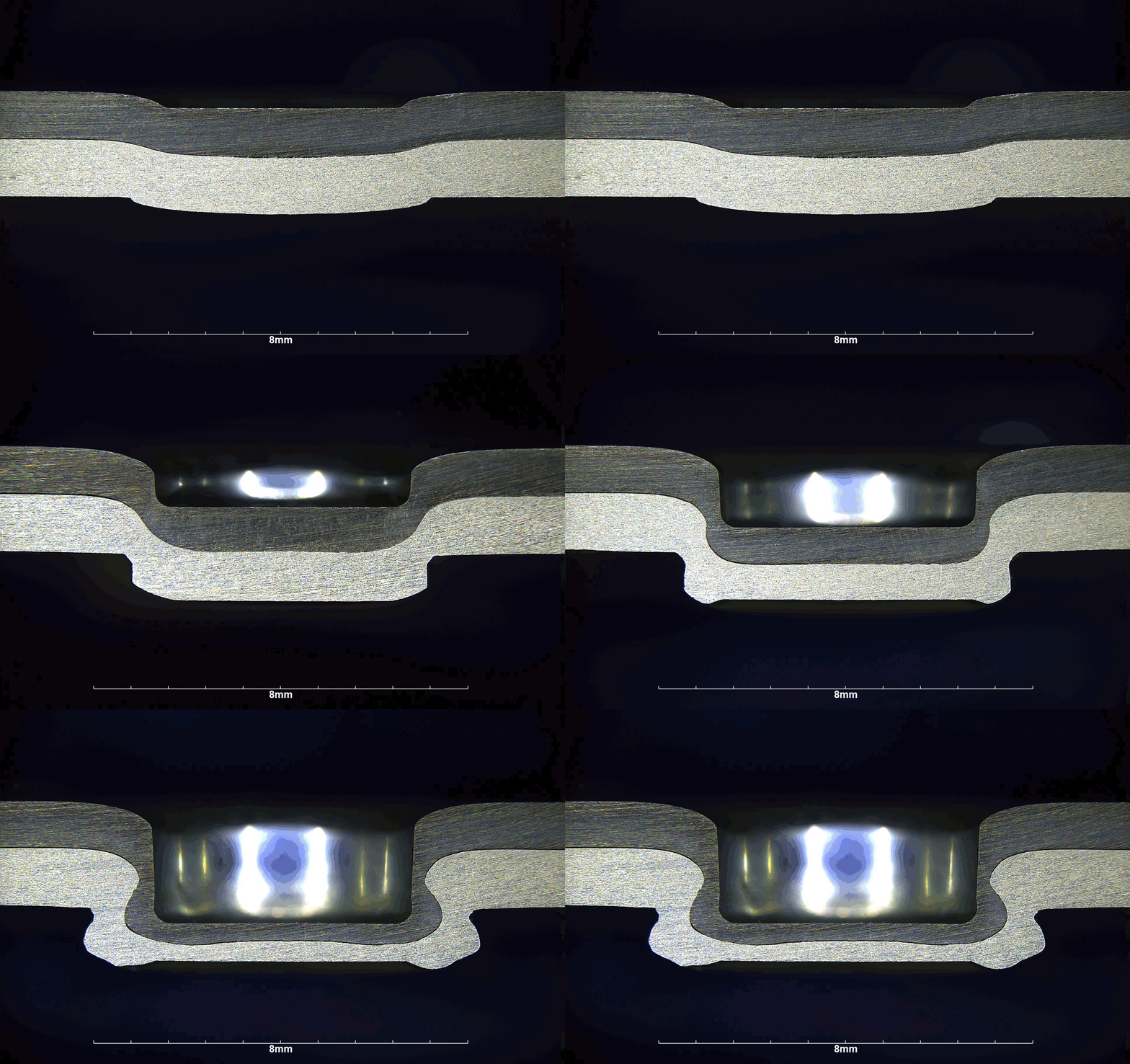
Der Clinchprozess im Schliffbild von TOX® Pressotechnik

Clinching as a joining technology

Clinching is an established joining technology for battery production that allows sheet metal and other materials to be joined without additional fasteners or thermal stress. This technology is particularly effective in the field of e-mobility due to its electrical conductivity and high process reliability.

Press Systems and Special-Purpose Machines

TOX® press systems offer a flexible platform for a wide range of applications — from press-fitting and forming to assembly. Thanks to their modular design, customized solutions can be implemented to meet various requirements in battery production.

Clinching tongs on robotic arms in an automotive assembly line

Multi Technology Platform

The Multi Technology Platform combines various joining technologies—such as clinching, riveting, and press-fitting — on a unified system basis. Standardized components and software ensure easy integration and operation in automated production lines.

Engineering partnership for stable production processes

As an engineering partner, TOX® supports projects from the initial analysis right through to series production integration:

  1. Assessment of material, geometry, and load requirements

  2. Feasibility analysis and testing

  3. Design of tooling and press systems

  4. Integration into existing or new production lines

  5. Validation and process monitoring

The aim is not merely to join two individual components, but to develop a robust, cost-effective, and scalable overall process.

Are you planning a project in the field of e-mobility and battery?

Are you planning a project in the field of e-mobility and battery?

Have your component evaluated or schedule an engineering consultation with our experts.

Frequently asked questions about manufacturing technologies in e-mobility and battery

How are battery modules connected in e-mobility?
What challenges exist in battery production?
How can quality be ensured in battery production?
What does traceability mean in battery manufacturing?
What advantages do modern joining technologies offer for e-mobility?
Why are aluminum joints in batteries particularly challenging?

High production volumes, maximum process reliability

Technologies in the field of e-mobility and batteries

eClinching

Electrically conductive connections on battery cells or in charging stations

Press-fitting

Press-fitting of functional components into vehicle bodies and battery housings

Clinching

Pierce-bonding of housing parts and battery components

Riveting

Riveting battery module housings and mounts for electric motors

Assembly

Mounting electronic components on the battery cell

Whitepaper: Battery Production & E-Mobility

Learn how to successfully overcome typical challenges in the production of battery components. In our whitepaper, you’ll find valuable tips on manufacturing aluminum battery housings, preventing corrosion and outgassing, and joining conductive materials. Get your free copy now.